Not everyone wants to operate a company along with another shareholder. Some people want to have complete control over their business decisions and keep all the profits for themselves. Also, when there is only one owner, there is no room for disputes arising from disagreements between shareholders. Earlier, for someone who wanted to be the sole owner of a business, a sole proprietorship was the only choice. However, it had one major drawback, i.e., the liability of the business was unlimited and was ultimately borne by the sole proprietor. Therefore, there was a need for a business structure that could provide limited liability protection while still allowing one person to have complete ownership and control.
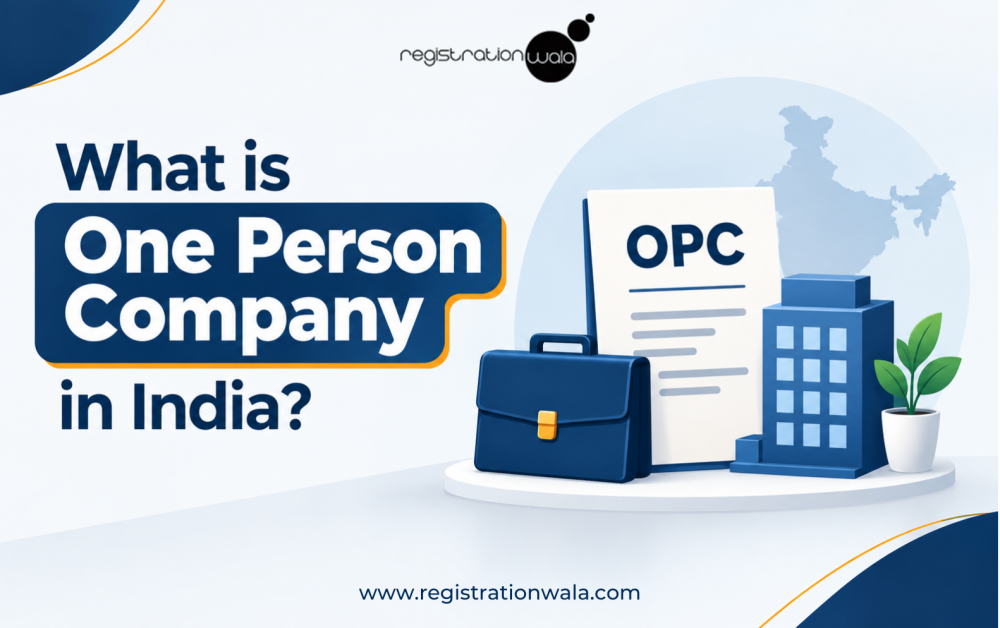
The One Person Company (OPC) was introduced to address this need. It offers the limited liability protection of a private limited company while allowing a person to remain the sole owner of the company and retain the profits. In this blog post, we shall discuss One Person Company in India in detail. So, if this corporate business entity has made you curious about starting a business, we recommend that you read this blog for complete clarity.
What is the Definition of OPC in Company Law?
OPC full form in company law is One Person Company. Under Section 2(62) of the Companies Act, 2013, a “One Person Company” means a company which has only one person as a member. Unlike other companies incorporated under the Act, an OPC is incorporated with only 1 shareholder and 1 director.
The director need not be a different person. The sole shareholder can be the director himself too. The maximum number of directors in such a company is up to 15 directors. In case more directors are needed beyond this limit, then a special resolution must be passed by the OPC.
In an OPC, the sole member holds 100% of the share capital and is entitled to 100% of the profits. The law also requires the words “OPC Private Limited” to be suffixed to the end of the company’s name. So, suppose the company’s name is Saahara Foods, then its full name as an OPC will be Sahara Foods (OPC) Private Limited.
Salient Features & Characteristics of an OPC
The salient features and characteristics of a one person company are described in this section. Once you go through all the features and characteristics of this company, you will understand why so many entrepreneurs opt for OPC registration:-
| OPC Features / Characteristics |
Description |
| Requirement of Single Shareholder and Director |
An OPC requires only one shareholder and one director for incorporation. |
| Separate Legal Entity from Shareholder |
It is treated as a legal entity that is separate from its shareholder. |
| Mandatory Suffix OPC Name |
Each and every OPC is required to use the suffix “OPC Private Limited” at the end of its legal name. |
| Newer Form of Business Entity |
Compared to various types of business entities like Private Limited Company, Limited Liability Partnership, Public Limited Company, Sole Proprietorship and Partnership Firm, the One Person Company is a newer form of business entity in India. It came into existence only after the Companies Act, 2013, came into force. |
| Ownership of Profits |
The sole shareholder of OPC gets to keep 100% of its profits. |
| Nominee Requirement |
While incorporating an OPC, the sole shareholder must choose a nominee. If needed, this nominee can be changed later on. |
| Concessional Tax Rate |
Under the corporate tax regime, the OPCs can opt for a concessional corporate tax rate of 22%. After including surcharge and cess, the effective rate becomes 25.17%. |
| Eligibility of Foreign Nationals |
A foreign national cannot establish an OPC in India. For OPC formation, the shareholder must be an Indian citizen. |
| Eligibility of Non-Resident Indians |
A non-resident Indian can establish an OPC following the Companies (Incorporation) Second Amendment Rules, 2021 w.e.f 1 April 2021. |
| Exemption from Annual General Meeting |
OPC compliance requirements are less stricter compared to other companies. It is exempt from holding an Annual General Meeting u/s 96(1) of the Companies Act, 2013. |
You May Also Read: Advantages of OPC
For OPC formation, there are certain non-negotiables pertaining to the eligibility criteria. If the eligibility for OPC in India is not met, then you must work on meeting it prior to filing an application for One Person Company registration.
-
Only a natural person can incorporate an OPC. No artificial person or company can be the owner of an OPC at any given point of time.
-
Along with this, there is a requirement that the person must be an Indian citizen. A Non-Resident Indian is fine too, but a foreign national cannot incorporate an OPC due to FDI restrictions.
-
The minimum age requirement for being an OPC owner is 18 years. Therefore, no minor can own an OPC. There is no maximum age limit for becoming a member of an OPC.
-
A nominee has to be mandatorily nominated for an OPC during the incorporation process itself, otherwise you cannot proceed ahead with starting the OPC. However, this nominee can later be changed or updated at a later stage during the course of business.
-
There is no room for multiple nominees or an alternative nominee in an OPC. Only one nominee can be appointed at a time.
-
One person can own only one OPC at a time and cannot have multiple OPCs simultaneously.
-
A person can be the nominee of only one OPC at any given point of time.
Learn More: Tax Benefits of OPC
How to Register an OPC in India?
Registering an OPC is a fairly simple process today, especially with an experienced consultant, as the entire process is online through the MCA portal. You need to obtain a DSC, file SPICe+ Part A for name reservation and then Part B with the MOA, AOA and other required documents for incorporation. Once approved by the ROC, you receive the Certificate of Incorporation.
To know the OPC registration process in detail, click here.
The 5 Structure Types of One Person Company
When we say OPC, we are being vague as to what exact type of OPC we are talking about. In total, there are actually 5 types of One Person Companies:-
-
OPC Limited by Shares:- Here, the liability of the sole owner is limited to unpaid amount, if any, on the shares held by them.
-
OPC Limited by Guarantee with Share Capital:- In this type of OPC, the liability of the member is limited to amount that they have undertaken to contribute to company’s assets in event of its winding up, along with their liability, if any, in respect of unpaid amount on shares they hold.
-
OPC Limited by Guarantee without Share Capital:- In this type, there is no share capital at all. Also, the liability of sole shareholder is limited to amount of guarantee that they have undertaken to contribute to company’s assets in the event of its winding up.
-
Unlimited OPC with Share Capital:- An OPC of this type has share capital. However, the liability of its sole member is not limited to amount unpaid on their shares. In such an OPC, the member may be personally liable for company’s debts and liabilities.
-
Unlimited OPC without Share Capital:- In this OPC type, the company does not have share capital. Also, the liability of the sole member happens to be unlimited, making it a bit similar to sole proprietorship. This means that the member may be personally liable for the company’s debts and liabilities without the protection of limited liability.
Need assistance in registering an OPC to make the process easier and smoother? Then you can connect with our OPC incorporation consultants at Registrationwala.
Speak to Our Expert
Frequently Asked Questions (FAQs)
Q1. Is it mandatory to register an OPC?
A. Yes. If you want to operate an OPC, you must mandatorily complete the OPC registration process with ROC, MCA.
Q2. Why should I register an OPC instead of running a sole proprietorship?
A. You should opt for OPC registration instead of operating a sole proprietorship to get limited liability protection against business debts and losses.
Q3. How long does it take to register an OPC in India?
A. It usually takes between 7 to 14 days to register an OPC in India as long as the application is filed accurately along with necessary documents.
Q4. Which form is the prescribed form for OPC incorporation?
A. The prescribed form for OPC incorporation is SPICe+. To incorporate an OPC, you need to fill out this form and file it on the official MCA portal.
Q5. What does One Person Company mean?
A. One Person Company means a company having only one person as its member/shareholder.
Q6. Can a foreign national own an OPC in India?
A. No. A foreign national cannot own an OPC in India. Only an individual who is an Indian resident can own such a company.
Q7. Can an NRI be an OPC director?
A. Yes. An NRI can be an OPC director as long as they fulfill the eligibility requirements.
Q8. What is One Person Company definition under the Companies Act?
A. Under the Companies Act, 2013, One Person Company meaning is defined as “a company which has only one person as a member.”